Wednesday, September 23, 2015

France Bloch-Serazin (1913-1943)

France Bloch, daughter of Jean-Richard Bloch, was born on 21 February 1913. After obtaining a degree in Chemistry, she began working at the laboratory of Professor Urbain at the National Institute of Chemistry. She joined the Communist party and became involved in the support of Spanish Republicans.

In May 1939 she married Fredo Serazin with whom she had one son: Roland. Fredo was a metallurgist working at the Hispano-Suiza automobile factory. He was arrested by the Daladier government in February 1940.

After the German occupation of France, France was barred from her laboratory as an Jewish communist and had to work as a tutor in order to survive. In 1941 she participated in the communist resistance group led by Raymond Losserand. She installed a rudimentary laboratory in her two-room apartment and made grenades and detonators used in attacks organized by the youth resistance at the end of August 1941.

France was arrested by the French police on 16 May 1942. After four months of interrogation and torture, she was condemned to death by a German military tribunal along with 18 co-conspirators who were immediately executed. France was deported to Germany and imprisoned in a fortress at Lubeck where she was subjected to further torture. She was decapitated by guillotine on February 12, 1943 in Hamburg.

Micheline Blum-Picard Glover (1924(-2000)

Micheline Glover, 76, a Bold Figure in the French Resistance

By William H. Honan
Published April 24, 2000
Found at www.nytimes.com

Micheline Glover, who as an 18-year-old girl worked for the French Resistance during World War II, delivering secret messages under the eyes of unwitting German soldiers, died April 15 in White Plains Hospital in White Plains, N.Y. She was 76.

Mrs. Glover, who was born in Paris, received a citation after the war from Gen. Dwight D. Eisenhower for one of her activities in the Resistance: rescuing Allied airmen shot down by the Nazis.

She recalled in a privately published memoir that she was first drawn to the Resistance -- the clandestine underground that sought to disrupt the German occupation of France -- when at age 16 she joined a student protest march in Paris. German troops fired on the students with machine guns, killing several.

Two years later, after Mrs. Glover had moved with her family to Montlucon, she discovered that her English tutor was in the Resistance, and she asked him whether she could do something ''to help our cause.''

Soon Mrs. Glover became a courier for Pierre Kaan, a philosophy professor who was a major figure in the Resistance. Professor Kaan, who was Jewish, was eventually captured and killed in a Nazi death camp.

Mrs. Glover's first assignments were riding trains throughout the country, carrying secret messages taped to her back. In this work, she seems to have had nerves of steel.

Once, the train in which she was riding came to a sudden halt. She and the other passengers were told to leave the train to have their identification papers checked. Mrs. Glover's papers were found to be unacceptable, and she was instructed to stand aside while other passengers were checked and questioned. She followed orders, but when the passengers with acceptable identification papers were told to return to the train, Mrs. Glover slipped away from her forgetful guard and quietly boarded the train as it pulled out of the station.

On one occasion, she recalled in her memoir, she sat in a cafe filled with German soldiers and passed messages to her contact, sipping a glass of wine.

Another time, in still another cafe filled with enemy soldiers, her contact whispered a desperate request to her to help him repair the package he was carrying. She did his bidding, but not without first discovering that the package contained a deflated rubber raft destined for some secret mission.

A more elaborate and perhaps even more dangerous mission involved photographing the damage sustained by a large tire factory that had been bombed by American aircraft.

She could not afford to be caught prowling a factory that produced strategic war materials, but in the rubble she came upon two American airmen who had been shot down in the attack. Somehow, she would have to spirit them out of the country. She procured a couple of bicycles for the airmen to ride by night, only to discover that neither knew how to ride a bicycle.

''I was very glad we did not meet any German patrols on our way,'' she wrote.

One of the airmen was later killed; the other escaped.

Mrs. Glover finished the war as an interpreter and was awarded a medal of honor from the French government.

She met her husband, Garlan Glover, at a Red Cross dance in Paris. The couple married and moved to White Plains in 1955. Mrs. Glover then devoted herself to raising a family.

Micheline Blum-Picard was born in Paris, the daughter of a French government official. She attended school in Montlucon.

In addition to her husband, Mrs. Glover is survived by a daughter, Christiane, of Ossining, N.Y.; four sons, Derek of Ridgefield, Conn., Brian of White Plains, Renny of Boulder, Colo., and Wayne of North White Plains; and six grandchildren.

Mrs. Glover recalled that in her Resistance work, after she received word that Allied forces were about to land on the Normandy coast, she asked to take part in the fighting. Her superiors decided that she could not be allowed to serve as a combat soldier, but rather as a nurse.

Nevertheless, she got her way. Even as a nurse, she was permitted to carry a rifle, a pistol and a hand grenade. She recalled that she fired repeatedly once the landings began, but could not be certain whether she hit anyone.

Boulloche Siblings

The Last Train Out of Paris


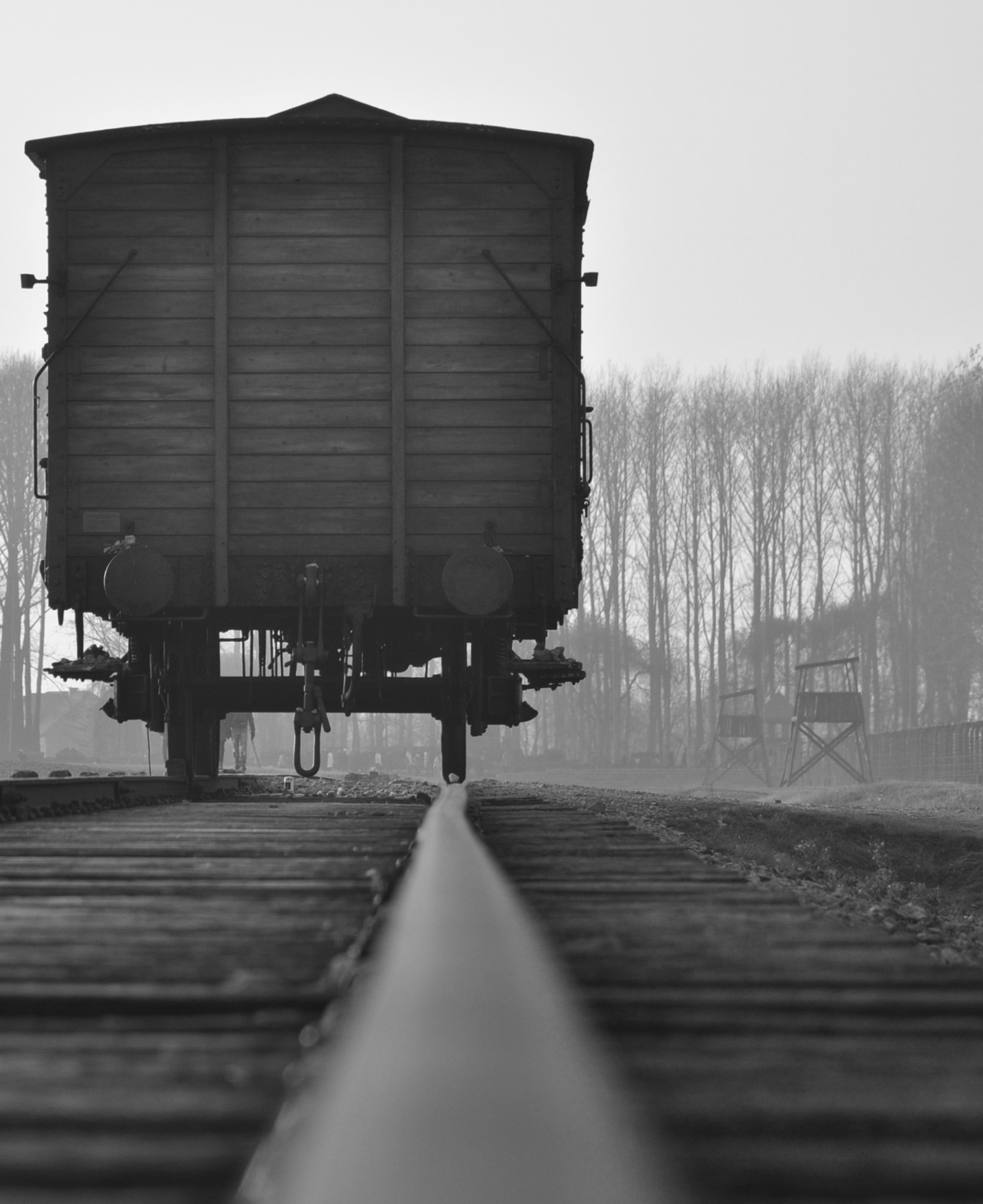
Auschwitz train. Photo by MaximilienM (2011)
At 3:00 AM on Sunday, 6 August 1944, Gestapo agents burst into the third floor apartment in Paris belonging to Jacques and Hélène Boulloche (28, avenue d’Eylau). They were looking to arrest Christiane Boulloche, Jacques and Hélène’s 20 year-old daughter. The Boulloche sisters, Christiane and Jacqueline, and their brother, André, had joined the fledgling resistance movement in Paris at the outset of the Nazi occupation beginning in June 1940.
What made these 3 Résistants different than most? Well, first of all, they survived (André was one of the few who returned from the extermination camps—three including Auschwitz). The life expectancy of a resistance member in Paris (especially after Hitler invaded the Soviet Union and the resistance movement became more active) was about 4-weeks. The second major difference was that they joined early on without having any political agenda. They joined because it was the right thing to do. Many of the Résistants during the subsequent years of occupation were communists and their leaders had political agendas. Towards the end when it became clear the Allies would liberate France and Paris, many people “joined” the resistance movement.
Jacques, Hélène, and the oldest son, Robert, did not join the resistance. Jacques and Robert were mid-level government bureaucrats who felt it was their duty to keep the country running (albeit under the Vichy regime). While they knew their 3 youngest children were involved, the parents knew nothing of their resistance activities. After the Allies successfully invaded Northern Africa in November 1942, the Germans took over France and eliminated the unoccupied zone. They also stepped up their brutality towards the citizens of Paris and France. They would now arrest, torture, and deport the immediate family members of a known or suspected Résistant.
Over the next week, visitors to the Boulloche apartment were detained and interrogated by the Gestapo and the French paramilitary police known as the Milice. During this time, the imprisoned Boulloches were tortured by the Gestapo (Hélène was water boarded) and when the Nazis finally determined these 3 people had no idea where Christiane was hiding, they were stuffed into a cattle car at the Pantin Station. Among the French prisoners on the train were André Boulloche’s friend and former school mate, André Rondenay, and another Résistant, Alain de Beaufort.
The train convoy left Paris on 15 August 1944 (ten days before the liberation of Paris). Less than an hour outside Paris, the train stopped and Rondenay and de Beaufort were taken off and loaded into a car. They were taken into the forest and executed by a Gestapo firing squad. The train was the last one leaving Paris that would arrive in Germany. It was also one of the few that did not carry Jews—only political prisoners (the Boulloche family were Catholic).
The men were taken to Buchenwald while the women went to Ravensbrück. Hélène died on 25 October 1944. After his wife’s letters stopped, Jacques died at Buchenwald on 18 February 1945, while Robert had succumbed on 20 January 1945 at a sub-camp of Dora-Mittelbau.
A black granite tomb inscribed Famille A. Boulloche is located at Pére Lachaise Cemetery in Paris. The names of the 3 family members, Jacques, Hélène, and Robert, are chiseled on the top. The grave is empty.
The full story of the Boulloche family during the occupation of Paris is told by Charles Kaiser in his book, The Cost of Courage. It’s a remarkable story that I urge you to read.
Found at www.stewross.com/the-last-train-out-of-paris.

Gabrielle "Gaby" Buffet-Picabia (1881-1985)


Jeanne Bohec (1919-2010)

Jeanne Bohec was born in 1919 in Plestin-les-Greves, France. Until the age of 10, when her father retired from the Navy, she accompanied her parents from port to port ending up in Angers where she spent her adolescence. An avid reader, her favorite books told the story of Belgian women of espionage during the Great War and naval battles.

In September 1939, as Poland was invaded by Germany, Jean started thinking about the 'approaching monster.' One day a stranger crosses her path and remarks, "Games are finished now, we have to think about the serious things." Jeanne recalls, "He could not know how much I agreed with him ... I felt an acute desire to do something. But what?" In Angers, and far from the war, she felt mostly useless and began to train in civil defense and first aid techniques.

The first attacks on Belgium happened on 10 May 1940 and were followed by a rapid advance into French territory. On June 18, preferring to not succumb to the defeatist discourse growing around her, she filled a large suitcase and told her cousin she was going to find a boat to England (her parents were away at the time). After several attempts, she found the tug Bee 4 was about to set sail. On board are 5-6 crew members, 2-3 crew wives and a family of four with their dog. At 1900 hours, as night falls, the tug's captain says, "Well, look back no further!"

They landed in Plymouth on June 21 and those on board were brought to a triage center where they were briefed by waiting intelligence officers. A few hours later, they were taken by train to London.

Once in London, Jeanne became involved with the French Volunteers of the Free French Forces. She worked first as a secretary and then as a chemist in the research laboratory involved in the manufacture of explosives. With the help of Henri Frenay, she entered the BCRA and began her training in sabotage. She eventually became an expert in plastique explosives.

On 20 February 1944 she was parachuted back into France, where she was greeted with, "What's going on? They're sending us children now!" Although she was better qualified than most men to use the machine guns that were parachuted it, her efforts to join in maquis combat were overruled. She was informed that women were not supposed to fight when men were available.

Jeanne died on 11 January 2010 and was buried in Plestin-les-Greves.

Celia Bertin (1920-2014) ~ aka Jean Voilier

Celia Bertin was born in Paris, Ile-de-France on 22 October 1920. Daughter of a boureois family, she was educated in Paris where she studied English literature.

She worked as a resistant for Pierre de Lescure, member of the Intelligence Service. Having fled Paris for security reasons, she was sent in October 1944 to Switzerland by Pierre-Henry Teitgen, an important leader of the Resistance. There she gave lectures on the Resistance.

Celia later married to Jerry Reich of New York and lived in Boston, New Hampshire, Maine and Paris where she died on 27 November 2014

Claudette Blance

Claudette Blance was an intelligence officer in the French Resistance (Maquis) and a lieutenant in the Free French Army. Her residence was used as a safe house by the Jude Jedburgh Team in 1944. As of this writing, nothing more is known of her. (JH Oct 2015)