Showing posts with label Ravensbruck. Show all posts

Thursday, September 24, 2015

Genevieve de Gaulle-Anthonioz (1920-2002)

Genevieve de Gaulle was the niece of General Charles de Gaulle. Her father was a diplomat and she spent much of her childhood traveling.

During WWII, she joined the Resistance movement at its early stage, recruiting Free France Resistance fighters. In 1944, she was arrested in Paris and shipped to the Ravensbruck concentration camp.

In her book The Dawn of Hope: A memoir of Ravensbruck, Genevieve documented the conditions of 75 Polish women in the camp who were operated on without anesthesia by a surgeon who later deliberately infected their wounds with gangrene, tetanus and streptococcus. She herself was subjected to beatings and near starvation conditions. After several months of performing backbreaking labor, she was mysteriously transferred to an area of the camp where inmates were treated less harshly. Shortly thereafter, she was put in a solitary confinement cell.

Since she did not know the reason for these changes, Genevieve expected to be executed at any time. What kept her from falling into total despair was the kindness of a fellow inmate, a Jehovah's Witness who brought her meals and gifts from other French prisoners. A few weeks after Paris was liberated, she was released from Ravensbruck and, in the 1950s, began a lifelong commitment to easing the plight of the poor. She died on 14 February 2002.

Wednesday, September 23, 2015

Boulloche Siblings

The Last Train Out of Paris


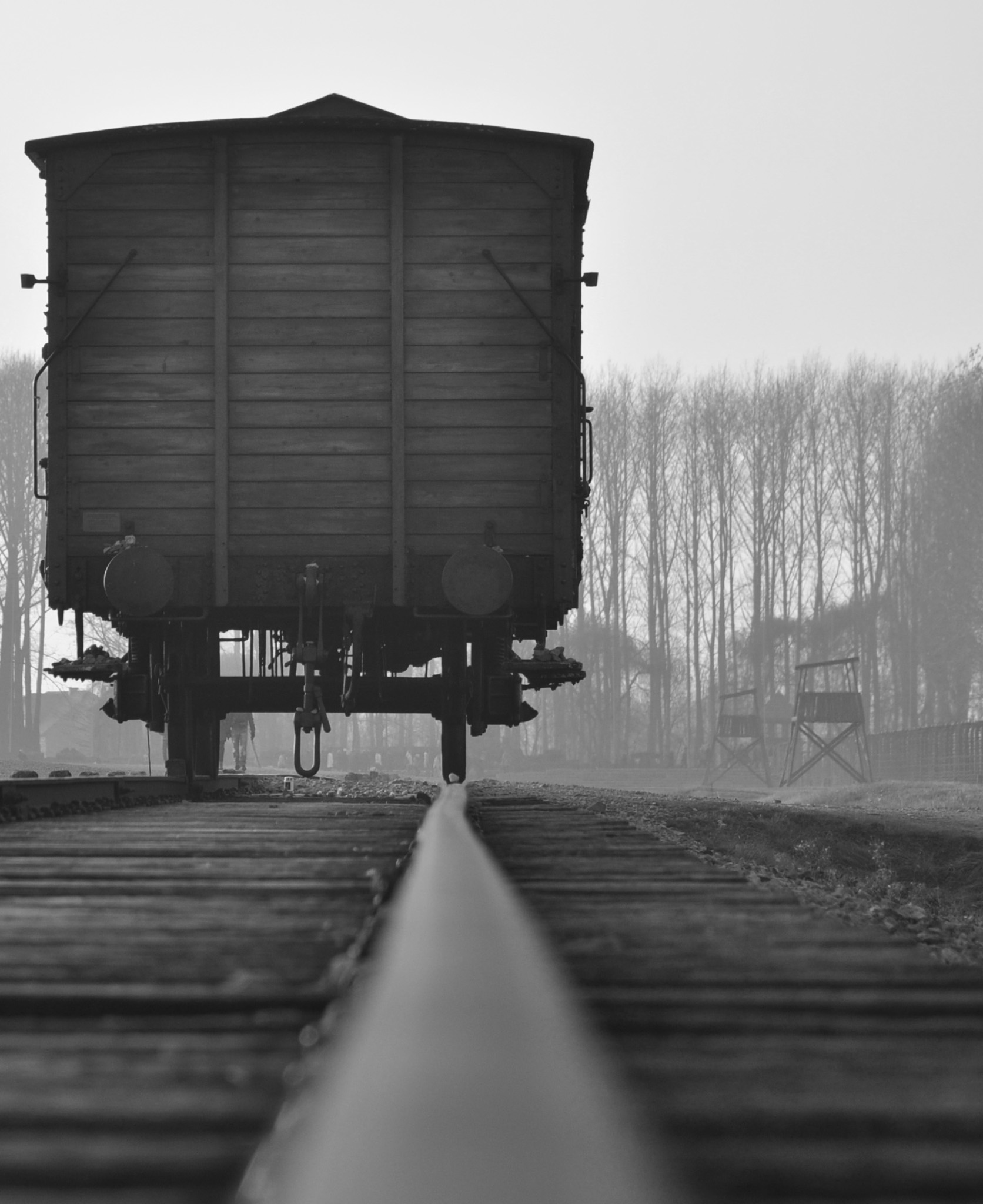
Auschwitz train. Photo by MaximilienM (2011)
At 3:00 AM on Sunday, 6 August 1944, Gestapo agents burst into the third floor apartment in Paris belonging to Jacques and Hélène Boulloche (28, avenue d’Eylau). They were looking to arrest Christiane Boulloche, Jacques and Hélène’s 20 year-old daughter. The Boulloche sisters, Christiane and Jacqueline, and their brother, André, had joined the fledgling resistance movement in Paris at the outset of the Nazi occupation beginning in June 1940.
What made these 3 Résistants different than most? Well, first of all, they survived (André was one of the few who returned from the extermination camps—three including Auschwitz). The life expectancy of a resistance member in Paris (especially after Hitler invaded the Soviet Union and the resistance movement became more active) was about 4-weeks. The second major difference was that they joined early on without having any political agenda. They joined because it was the right thing to do. Many of the Résistants during the subsequent years of occupation were communists and their leaders had political agendas. Towards the end when it became clear the Allies would liberate France and Paris, many people “joined” the resistance movement.
Jacques, Hélène, and the oldest son, Robert, did not join the resistance. Jacques and Robert were mid-level government bureaucrats who felt it was their duty to keep the country running (albeit under the Vichy regime). While they knew their 3 youngest children were involved, the parents knew nothing of their resistance activities. After the Allies successfully invaded Northern Africa in November 1942, the Germans took over France and eliminated the unoccupied zone. They also stepped up their brutality towards the citizens of Paris and France. They would now arrest, torture, and deport the immediate family members of a known or suspected Résistant.
Over the next week, visitors to the Boulloche apartment were detained and interrogated by the Gestapo and the French paramilitary police known as the Milice. During this time, the imprisoned Boulloches were tortured by the Gestapo (Hélène was water boarded) and when the Nazis finally determined these 3 people had no idea where Christiane was hiding, they were stuffed into a cattle car at the Pantin Station. Among the French prisoners on the train were André Boulloche’s friend and former school mate, André Rondenay, and another Résistant, Alain de Beaufort.
The train convoy left Paris on 15 August 1944 (ten days before the liberation of Paris). Less than an hour outside Paris, the train stopped and Rondenay and de Beaufort were taken off and loaded into a car. They were taken into the forest and executed by a Gestapo firing squad. The train was the last one leaving Paris that would arrive in Germany. It was also one of the few that did not carry Jews—only political prisoners (the Boulloche family were Catholic).
The men were taken to Buchenwald while the women went to Ravensbrück. Hélène died on 25 October 1944. After his wife’s letters stopped, Jacques died at Buchenwald on 18 February 1945, while Robert had succumbed on 20 January 1945 at a sub-camp of Dora-Mittelbau.
A black granite tomb inscribed Famille A. Boulloche is located at Pére Lachaise Cemetery in Paris. The names of the 3 family members, Jacques, Hélène, and Robert, are chiseled on the top. The grave is empty.
The full story of the Boulloche family during the occupation of Paris is told by Charles Kaiser in his book, The Cost of Courage. It’s a remarkable story that I urge you to read.
Found at www.stewross.com/the-last-train-out-of-paris.

Thursday, September 17, 2015

Adelaide Hautval (1906-1988)

Adelaide Hautval was born to a Protestant family in Hohwald (Bas Rhin), France in 1906. She studied medicine in Strasbourg, going on to work in several psychiatric wards.

In April 1942, she was told of the death of her mother who lived in occupied Paris. Wishing to attend her mother's burial, Adelaide asked German authorities for permission to cross the demarcation line separating the two zones of France and was refused. Her attempt to make a crossing without the permit failed: Adelaide was arrested by the German police and transferred to the prison in Bourges.

That June, Jewish prisoners wearing the yellow patch began to arrive at the prison. As she awaited her, she protested the harsh treatment of Jewish prisoners who were incarcerated with her. The reply was that from now on she would share their fate. Undeterred, Adelaide pinned a piece of yellow paper to her clothing that read, "Friend of the Jews."

After incarceration in several detention camps, she was sent with 200 other French women to Auschwitz in January 1943 on a train that became known as the Convoi des 31000. She was housed with 500 Jewish women who nicknamed her "the saint."

She applied her medical knowledge to treat Jewish prisoners who had contracted typhus, secluding them in a separate part of the block, in order to prevent contagion. Employed as a physician by the camp commander, she refrained from reporting the prisoners’ illness and thereby spared them immediate death. She treated Jewish patients with boundless dedication, and her gentle hands and warm words were of inestimable value to Jews in the hell of Auschwitz. “Here,” she said, in words engraved on the prisoners’ memory, “we are all under sentence of death. Let us behave like human beings as long as we are alive.”

Adelaide was assigned to Dr. Eduard Wirths who conducted sterilization experiments on Jewish women in the infamous Block 10 at Auschwitz. She quickly discovered that the experiments were performed without anesthesia. When forced to assist in the surgical sterilization of a young woman from Greece, Dr. Hautval told Dr. Wirth that she would never again attend such a procedure. When Wirth asked Dr. Hautval: “Don’t you see that these people are different from you?” she replied, “In this camp, many people are different from me. You, for example.” 

After her confrontation with Dr. Wirths, she was advised to stay out of sight. She feared retribution but was not punished. In August 1944 she was moved to Ravensbruck where she continued to practice medicine and heal prisoners as much as possible until the camp liberated in April 1945. When she returned to France, her health had been permanently impaired.

Sunday, September 13, 2015

Helene Langevin-Solomon (1909-1995)

Helene Langevin was the daughter of the great scholar Paul Langevin and wife of writer Jacques Solomon, who she married in 1929.

On 2 March 1942, Jacques was arrested in a Paris cafe where he was having a working meeting for L'Universite'. He was interned at the police station until March 20, then at Cherche-Midi prison until May 11 and finally at La Sante Prison. He was handed over to the Germans and shot as a hostage on May 23 at Fort Mont-Valerien.

Helene was arrested on 10 March 1942 and eventually put on the Convoi des 31000 for Auschwicz. She was later transferred to Ravensbruck.

Sylvette Roussel Leleu (1909-1989)

Sylvette Roussel, daughter of x and x, was born in Bruay,France on 1 February 1908.

Tall, brunette, with very expressive eyes. With the loss of her husband, Gilbert Leleu, in September 1939, she vowed to avenge his death. "I will avenge my husband's death, I will fight for the future of my children. I will make war on the Germans. God help me and have pity on them."

She answered De Gaulle's "call of June 18" and became a member of the Musee de l'Homme resistance group which was one of the first organized resistance movements in France. The group was infiltrated by a traitor and betrayed, causing most of the group to be arrested in the beginning of 1941. Sylvette was one of 19 members who were tried and convicted. She was deported to Ravensbruck where she was held until the liberation.

She died in Bethune, France on 3 October 1989.

Lise Lesevre (1901-)

Waiting To Testify At 86, She's Still Impaired By Barbie's Torture

By Jack McKinney
POSTED: February 4, 1987
Phylly.com


When the shadow of Adolf Hitler began to lengthen over Europe, there was much brave whistling in the dark from France.

Their country was not some pushover like Czechoslovakia or Poland, the French tune went. The Panzer divisions would be impaled on France's vaunted Maginot line. The Boche would never occupy French soil.

But when Hitler's armored divisions rumbled into France from conquered Belgium on May 12, 1940, all this bravado evaporated. After only 46 days, the fighting was over, and a puppet French government was installed at Vichy.

From a radio studio in London, French tank commander Charles de Gaulle broadcast an appeal to his countrymen across the English Channel. "Come what may," he told them, "the flame of French Resistance must not go out and will not go out!"

Despite the lofty claims that would emerge later, pitifully few French citizens heeded de Gaulle's call. One of the bravest who did was a 39-year-old teacher named Lise Lesevre. She and her husband George immediately became active resistants in the region of Lyon.

Lise Lesevre's courage never faltered, but her luck ultimately failed her in late March, 1944, when she was apprehended carrying plans for the bombing of a German barracks. At Gestapo headquarters, she was confronted by the most feared Nazi in the entire region.

"He was terrifying to see," Lesevre recalled. "He had small eyes . . . that moved constantly. They made you think of a wild animal, those eyes . . . He had a riding crop, and he slapped his boots constantly with it."

This was intelligence chief Klaus Barbie, notorious "Butcher of Lyon."

"You are going to talk," Barbie confidently announced, striking Lesevre across the face to begin a sadistic interrogation that would last 19 days.

Lesevre's ordeal included immersion in a tub of ice water, her head repeatedly forced under to the point of near-drowning. Her body was stretched on a metal rack. She was hung naked by her wrists and flogged.

"It was always Barbie," she said. "Sometimes he had someone relieve him, but he always took over again to finish up. It was terrible."

But in the end, it was Barbie who gave up. Unable to make Lesevre talk, he congratulated her and sent her to a cell to await execution. Through a guard's error, she was put in the wrong cell. Instead of being shot, she was included in a convoy of prisoners to Ravensbruck concentration camp.

Her husband and their only son were to die as Nazi prisoners. But miraculously, Lise Lesevre survived.

Last week, Lesevre again confronted Klaus Barbie in Lyon, where he'd been imprisoned, pending trial for "crimes against humanity," since being deported from Bolivia in early 1983.

The shock of seeing his former victim may have had something to do with Barbie's transfer to a hospital the next day. French officials won't reveal the nature of Barbie's sudden indisposition. Other sources say he faces possible prostate surgery.

Whatever, whenever, Lesevre will be waiting to testify against Barbie. She is 86, and unable to raise her arms above her head because of the tortures Barbie inflicted. But her will is strong, and her memory sharp.

In addition to the physical torments she endured, Lesevre remembers the psychological agony of being forced to watch some of her own countrymen accept money from Barbie for the resistants they betrayed.

While still safe in Bolivia, Barbie sought to minimize the risk of being deported back to Lyon by threatening that he could yet identify many highly placed French citizens as his secret wartime collaborators.

With Lise Lesevre on hand to help stimulate his memory, it is hoped that the Butcher of Lyon will finally name the traitor who sold him his most celebrated victim, the legendary Resistance leader Jean Moulin.

Saturday, September 12, 2015

Micheline Maurel (1916-2009)

Micheline Maurel, daughter of radio pioneer Edourd Maurel, was born in Toulon, France on 17 July 1916.

She joined the Marco Polo Resistance network in November 1942 and was arrested by the Gestapo on 19 Jun 1943. Micheline was interned at Fort Romainville before being deported to Neubrandebourg (an annex of Ravensbruck) on 29 August 1943.

Twenty months later, in April 1945, she was liberated by the advancing Russian troops and returned to Toulon where she held a teaching position from September 1946 to June 1948. She left her teaching position to become a translator at the World Health Organization and headquarters of the International Red Cross in Geneva.

In the late 50s, she embarked on writing and publishing several works: memories of the camps, children's stories and poetry. Affected by the suicide of her adopted daughter, Magali Maurel (1961-1990), She published a collection of poems in Magali's memory. Micheline holds the Croix de Buerre with palm, the Commemorative Medal of voluntary services in Free France and Knight of the Legion of Honour.


Laure Mutschler-Diebold / Diebolt (1915-1965)

Laure Mutschler, the daughter of a French patriot family, was born in Erstein, Alsace-Lorraine, Germany on 10 January 1915. She spent her childhood in Sainte-Marie-aux-Mines where her parents lived from the year 1922. At the end of her studies, she became an administrative assistant in the Etablissements Baumgartner.

In 1940, Laure joined the "A.V." (Army of the Volunteers) resistance network of Dr. Bareiss in annexed Alsace and became a special agent under the name "Mado". Her assignment was to hide escaped war prisoners at her home in Alsace before helping them to escape to France.

Just before Christmas 1941, she was hidden in a locomotive and secretly brought to the free south of France. There she worked as an administrative assistant in the service which works with refugees from Alsace and from 1942 she collected information for the Resistance network "Mithidate" before encoding them and sending them to London by post mail.

On January 31, 1942, Laure married Eugène Diebold, who also escaped to Lyon. In July of that year they were arrested and later released by the Gestapo. They moved to Aix-les-Bains where Laure became known only as "Mona".

In September 1942 Laure was promoted to the rank of Lieutenant of the Free French Forces. She was assigned to the position of private secretary of Jean Moulin. After his arrest in 1943, she was sent to Paris to be the secretary of Georges Bidault.

She was arrested again on 23 November 1943 with her husband and sent to Fresnes Prison. She was not tortured because she convinced her Nazi captors that she was just a secretary and not a major figure in the Resistance network. Nevertheless, she was sent to the Schirmeck Nazi camp. Between January 1944 and her liberation in April 1945 she was transferred to AuschwitzRavensbrück and Buchenwald.

Laure died in Lyon on 17 October 1965 in Lyon and, in accordance with her last wishes, was buried in her childhood place Sainte-Marie-aux-Mines in Alsace. 

Renee Mirande-Laval (1908-1979)

Renée Mirande-Laval was born in Paris on 31 August 1908. She studied jurisprudence and became a lawyer. During the German occupation of France she defended arrested members of the French resistance in court.

In March 1943, she was arrested by the Gestapo and brought to Ravensbrück. During her first days in the camp she decided to bear witness to everything that took place there. After her release she worked untiringly as a chairperson of "L'Amicale de Ravensbrück,° the organization of French survivors of the camp, and as the first president of the "Comitee International de Ravensbrück," She died on 10 April 1979.

Friday, September 11, 2015

Yvonne Oddon (1902-1982)

Yvonne Oddon was born 18 June 1902 in Gap, Hautes-Alpres to a protestant family. She graduated from the University of Michigan's library school at a time when few French people studied in America and became one of France's leading specialists in the comparatively new field of modern library science, When the Paris Musee de l'Homme opened its doors, she was appointed head librarian and was instrumental, before and after the war, in organizing France's libraries.

Yvonne was an early resister of the German occupation. In 1940 she took part, with Boris Vildé and Agnès Humbert, in the creation of a resistance group called the Groupe du musée de l'Homme, initially to help prisoners and aviators to escape. She was also present at the birth of the clandestine newspaper Résistance

On 10 February 1941 the participants of the group were arrested following their denunciation by an employee. On 7 February 1942, the six men in the group were sentenced to death, but for the three women, including Yvonne, the sentence was suspended and they were deported to Germany. She went to several prisons before being sent to the camp at Ravensbrück on 20 November 1944. Freed by the International Red Cross, she arrived back in Paris on 14 April 1945 as part of an exchange negotiated between the Red Cross and Heinrich Himmler.

Yvonne was awarded the rank of Chevalier (Legion d'honneur) for her resistance work and was later promoted to Officier. She died in 1982 and was buried at Menglon (Drome), Rhone-Alpes, France.

Wednesday, September 9, 2015

Andree Virot-Peel (1905-2010)

Andrée Marthe Virot was running a beauty salon in the port city of Brest when the Nazis invaded in 1940. She joined the Resistance, initially distributing clandestine newspapers. Under the code name Agent Rose, she helped over 100 British and American pilots escape from Nazi-occupied territory onto submarines and gunboats, and also guided Allied planes to secret landing strips.

Her first act of defiance took place as German troops entered her town of Brest, when she gave shelter to a group of fleeing French soldiers and begged her neighbors for civilian clothes for them so they would not be captured.

When General de Gaulle declared in his famous broadcast of June 18 1940 that "France has lost a battle, but she has not lost the war," Andrée and some friends got together to type out the message and slip copies through people's letterboxes. At this point she became more involved in the Resistance, circulating the organization's newspaper. Within weeks she was made head of an under-section of the organisation, responsible for sending information to the Allies.

During the war, Brest was an important naval base, and information about shipping movements was vital to the Allied war effort. By establishing contacts in the dockyard, Andrée was able to pass on information about naval installations, as well as about troop movements and the results of Allied aerial attacks.

These were mainly directed at the harbor area, but many bombs missed their target and fell on the town. No one blamed the Allies. She recalled one man whose house had been destroyed leaping with joy when he found that his precious radio, on which he listened to the BBC, had survived intact. On another occasion she came across a group of teenage boys singing "What joy, Tommy, now that we are united at last" to a well known tune, as British bombs rained all around.

Andrée Marthe Virot was born on February 3 1905 into a religious and deeply patriotic French family. Her father was a civil engineer who specialized in building bridges. When she returned to a devastated Brest after the war, she learned that he had been killed after walking too close to a German soldier who was fishing using hand grenades. A brother had also lost his life in Germany while fighting in the ranks of the Free French. 

Andrée left Brest and returned to Paris where she became the manager of La Caravelle, a restaurant near the Luxembourg Gardens specializing in "first class cuisine at acceptable prices." News that she was a former Resistance worker attracted many clients including leading politicians and former Allied servicemen. 

One day a young English student called John Peel came into the restaurant. He was supposed to be learning French, but his accent was so comical that Andrée offered to give him lessons. Though he was 20 years her junior, a relationship developed, and they ended up getting married. Her husband made his career as a neuropsychologist at Barrow Gurney mental hospital in Bristol and they settled in a village nearby.

The Work of the Resistance

The work Andrée assumed was extremely dangerous. Any family found harboring an Allied airman risked being shot and in 1943 Andrée herself was forced to leave Brest after a comrade (who had been forced to watch his family being tortured by the Gestapo) informed on her.

She fled to Paris and assumed another identity, but a week after D-Day she was again betrayed by a comrade, who confessed under torture. She was arrested and taken to Gestapo headquarters where she was stripped naked, interrogated and subjected to a series of tortures, including simulated drowning and being savagely beaten around the throat. As a result her gullet was displaced and her tonsils crushed. She continued to suffer pain for the rest of her life.

Ravensbrück Camp

Eventually she and other prisoners were transported to the women's concentration camp at Ravensbrück where, on arrival, they were forced to strip and frogmarched into what she later realied was a gas chamber. She never discovered why they were released since many others lost their lives. She noticed later that the camp did a brisk trade with local farmers who bought the ashes from the camp crematorium to spread on their fields.

Andrée narrowly escaped death on several more occasions. She fell ill with what a doctor told her was meningitis, but recovered. Then, during the daily roll call, she was selected for the gas chamber but was saved by a Polish fellow inmate who crept up to a table and snatched up the piece of paper with Andrée's number on it without being seen by the SS.

Eventually she was transferred to Buchenwald concentration camp where life seemed easier, initially at least, and she was able to send messages to her family in Brest via French prisoners-of-war working in the fields outside. But, as the Allies closed in towards the end of April 1945, it became obvious that the Nazis were determined to obliterate evidence of their crimes. By the time she and a group of fellow prisoners were lined up against a wall, they had heard that some prisoners had been shot and others killed with flame throwers, so they had little doubt what was in store.

As a firing squad drew near, she wrote later, the terrified prisoners heard a telephone ringing in the camp commandant's office. It was a message from the Americans to the effect that the firing squad had been seen entering the camp and that if they wanted to live, they would spare the lives of the prisoners. The soldiers fled.

Mrs. Peel Speaks of the War
Mrs. Peel, who says she was 'too old' to have children by the time the war had ended, said, "The war is a time I will never forget. I don't think anybody who lived during that period ever really can, but I lived a different life to many women as I fought like a man. There weren't many women in the sort of role which I had. In my house in Brest I used to hide the British and help them with their orders. I'd also tell them what they should be doing next and passed on information. This was extremely dangerous as the Germans had occupied France during this time. Under the Germans everyone had to be at home and have their curtains closed by 6 pm and it used to terrify me that the comings and goings at my house would be discovered."

Her first role was distributing clandestine newspapers, but within weeks she was made head of a section in the Resistance reporting on troop movements, naval installations and the results of Allied attacks. "Agent Rose" and her team used torches to guide Allied planes and smuggled fugitive airmen on to submarines and gun-boats on remote parts of the coast. She fled to Paris and assumed another identity when the Gestapo closed in on the Resistance network in Brest. Captured by the Nazis, she was imprisoned at the Ravensbrück and Buchenwald concentration camps. She later recalled how she was being lined up to be shot by a firing squad when U.S. troops arrived to liberate the inmates in April 1945.

Mrs. Peel kept the striped blue and grey camp uniform she was forced to wear in the concentration camp as a reminder and said, "It was a terrible time but looking back I am so proud of what I did and I'm glad to have helped defend the freedom of our future generations." She continued, "You don't know what freedom is if you have never lost it. Everybody was ready to contribute to the fight and to risk their lives. It was a kind of fear that was not really fear. We had accepted we would die. The only fear we had was of being tortured and of speaking under torture. I rarely thought of my personal safety, I just acted and did what I believed was the right thing."

Found at www.voiceseducation.org
Submitted by Marilyn Turkovich 29 March 2010

Francette Pejot-Jarre (1914-2010)

In January 1942, inspired by Radio London broadcasts, Francette joined the Sniper Resistance network led by Jean-Pierre Lévy. She was arrested on 24 October 1942 when his apartment was raided by the French police and imprisoned until February 1943 at the Prison Saint-Joseph de Lyon.

At the end of 1943, she escaped arrest by the militia and joined several leading members of Sniper in Paris. She was arrested by German police on 30 June 1944 and deported to Ravensbrück on August 25. When the camp was evacuated in April 1945, she managed to escape with five comrades.

Francette Pejot was born in Lyon, France on 17 October 1914. In March 1946 she married Maurice Jarre with whom she had a son, Jean-Michel Jarre (the composer of electronic music). The couple divorced 5 years later. She died on 21 April 2010 in a hospital southwest of Gerard Collumb, France. Her son later wrote:

"My mother was a very important influence on me. She was an important figure in the French Resistance. I think she gave me a sense of tolerance and a sense of loyalty to your beliefs. When I was a child and even through my teens and as a young adult there was a profound anti-German feeling in France. My mother taught me the difference between Nazis and Germans, she taught me to never confuse the people with an idea."

Monday, September 7, 2015

Violette Robert-Maurice (1919-2008)

Violette Robert, daughter of Maurice Robert, was born in St. Stephen, France on 23 March 1919.

She was a student at Lyon, when she heard General de Gaulle's "Appeal of June 18th" and joined the Resistance. Violette founded clandestine movement "93" in Saint-Etienne with Claudius Volle and Denise Bonhomme. They published a newspaper by the same name. Suspected by the Vichy police in 1943, Violette then joined the Mithridates network in Lyon. There she met Jean Mouline, whose mission was to bring together local resistance networks.

On 9 October 1943 Violette and her father was arrested by the Gestapo. She was incarcerated at the Montluc Prison before being deported to Ravensbruck (Nacht un Nebel block) with Genevieve de Gaulle-Anthonioz and other heroines of the resistance. She was there for one year before being sent to Mauthausen. She was liberated by the Red Cross on 22 April 1945.

Her poems, written during her concentration camp imprisonment, bear testimony to the conditions suffered there. From 1984, she dedicated herself to writing memoirs, poetry and testimonies of deported Resistance prisoners.

Violette disappeared from her home at Chasseur Horizons on 21 November 2008.

Mila Racine (1919-1945)

Mila Racine was born in Moscow on 14 September 1919 but immigrated to Paris with her family. On the eve of the German occupation of the city, the family fled to southern France.

Simon Lévitte, the director of the EIF (Eclaireurs Israelites de France) scouting movement, brought Mila to work in the documentation center he established in the town of Moissac (in the Tarn-et-Garonne district), near the youth movement’s dormitory. When the south of France was occupied in November 1942, Lévitte moved the documentation center to the city of Grenoble (Isère), in the Italian-occupied area. Mila also moved to Grenoble. 

From that time the documentation center was operated both by the EIF and by the Zionist movement MJS (Mouvement de la Jeunesse Sioniste). After the Germans overran the Italian-occupied area in September 1943, the MJS assembled a group of activists who volunteered to smuggle children and young people across the Swiss border. Mila was a major activist in the group, but on 21 October 1943, she was arrested by the German border police together with the children she was guiding. All of them were taken to the Gestapo compound in the city of Annemasse, adjacent to the border. She succeeded in concealing her Jewish identity and was deported to Ravensbrück. The children were rescued by members of the underground.

On March 30, 1945, Mila was killed in an aerial bombardment.
Found at www.jwa.org.

Elise Rivet (1890-1945)

Elise Rivet, also known as Mere Marie Elisabeth de l'Eucharistie, was born to an Alsatian mother and French naval officer father. After the death of her father in 1910, she moved with her mother to Lyon. She worked for a time in a hair salon before joining the convent of the medical sisters of Notre Dam de Compassion in Lyon.

After France fell to Germany in WWII, she began hiding refugees from the Gestapo and eventually used her convent to store weapons and ammunition for the Mouvements Unis de la Résistance (MUR) at the request of Albert Chambonnet.

On 24 March 1944, she and her assistant were arrested by the Gestapo and taken to the Montluc prison in Lyon. From there, she was taken to Romainville, before being shipped to the Ravensbrück concentration camp. There, stripped of her religious garments, she was forced into hard labor. Mere Elisabeth volunteered to go to the gas chamber in place of a mother on 30 March 1945 ... only weeks before Germany surrendered unconditionally.

Jacqueline de La Rochebrochard-d'Alincourt / Pery (1919-2009)

Jacqueline de La Rochebrochard, eldest of a large family of old Breton nobility, was born in Prisse-la Charriere on 20 December 1919.

She married Joseph d'Alincourt, a young artillery lieutenant, in the summer of 1939. Joseph, who fought valiantly during the campaign of France, was killed during his captivity in Germany. After his death, Jackqueline moved to Paris where she found a job. Outraged by the sight of a child wearing the yellow star, she never stopped wanting to fight the Nazi occupiers.

In spring 1942, through her friend Claire Chevrillon, she was recruited by Jean Ayral, regional chief of the Office of Air Operations (BOA), a close collaborator of Jean Moulin. Jacqueline, alias Violaine, was responsible for encoding messages sent to the BCRA in London. She became the assistant of Daniel Cordier and was responsible for finding "mail boxes" to collect clandestine mail from all over for France and for ensuring the organization of secret agents from London (residential, industrial blankets, false papers and ration cards, etc.).

Jacqueline was arrested in Paris by the Gestapo on 24 September 1943, She suffered violent interrogations for five days and then held incommunicado in Fresnes prison for six months. In April 1944, after a stay  in Romainville, she was deported to Ravensbrück. There she found Geneviève de Gaulle, the niece of the leader of Free France, and became friends with Germaine Tillion, Anise Postel-Vinay and Margarete Buber-Neumann.

Saved by the Swedish Red Cross, she left Ravensbrück in April 1945, bringing with her the secretly written manuscript of Germain Tillion's operetta's The Verfügbar in the Underworld.

On her return from exile, she married Pierre Pery, a resistant who had been deported to Buchenwald. Jacqueline died on 21 April 2009

Click HERE to read
Surviving Ravensbruck
"Forgive, Don't Forget"
A memoir by Jacqueline Pery d'Alincourt

Saturday, September 5, 2015

Germaine Tillion (1907-2008)

Germaine Tillion, daughter of Lucien and Emilie Tillion, was born in Allegre, France on 30 May 1907.

She spent her youth with her family in Clermont-Ferrand and left for Paris to study social anthropology. Four times between 1934 and 1940 she did fieldwork in Algeria, studying the Berber and Chaoui people in the Aures region of northeastern Algeria, to prepare for her doctorate in anthropology.


As she returned to Paris in 1940, France had been invaded by Germany. As her first act of resistance, she helped a Jewish family by giving them her family's papers. She became one of the leading commanders in the French Resistance in the network of the Musée de l'Homme in Paris. Her missions included helping prisoners to escape and organizing intelligence for the allied forces from 1940 to 1942.

Betrayed by the priest Robert Alesch who had joined her resistance network and gained her confidence, she was arrested on 13 August 1942. On 21 October 1943 Germaine and her mother (also a resistante) was sent to the Ravensbrück concentration camp. From her arrival on 21 October 1943 to the fall of the camp in spring 1945, she secretly wrote an operetta comedy to entertain fellow prisoners. "Le Verfügbar aux Enfers" describes the camp life of the "Verfügbar" (German for "disposable", the lowest class of prisoners who could be used for any kind of work). At the same time she undertook a precise ethnographic analysis of the concentration camp.


Female Prisoners at Ravensbruck
Her mother was killed in the camp in March 1945. Germaine escaped in the spring of that year with a rescue operation of the Swedish Red Cross that had been negotiated by Folke Bernadotte.

In 1973, she published Ravensbruck: An eyewitness account of a women's concentration camp, detailing both her own personal experiences as an inmate as well as her remarkable contemporary and post-war research into the functioning of the camps, movements of prisoners, administrative operations and covert and overt crimes committed by the SS. She reported the presence of a gas chamber at Ravensbruck when other scholars had written that none existed in the Western camps, and affirmed that executions escalated during the waning days of the war, a chilling tribute to the efficiency and automated nature of the Nazi "killing machines."

She documented the dual but conflicting purposes of the camps; on the one hand, to carry out the Final Solution as quickly as possible, and on the other, to manage a very large and profitable slave labor force in support of the war effort (with profits reportedly going to SS leadership, a business structure created by Himmler himself).

Finally, she gave chilling vignettes of prisoners, prison staff and the "professionals" who were central to the operation and execution of increasingly bizarre Nazi mandates in an attempt to explore the twisted psychology and outright evil behavior of often average participants who were instrumental in allowing, and then nurturing the death machines.

To celebrate her 100th birthday, her operetta "Le Verfügbar aux Enfers" premiered in 2007 at the Théâtre du Châtelet in Paris. Germaine died at Saint-Mande, France on 18 April 2008.

Thursday, September 3, 2015

Marie-Claude Vogel Vaillant-Couturier (1912-1996)

Marie-Claude Vogel, daughter of magazine editor Lucien Vogel and fashion photographer Cosette de Brunhoff, was born in Paris on 3 November 1912.

She chose to be a photographic reporter, at the time when the trade was uniquely male, and earned herself the nickname of “the lady in Rolleiflex”.

In 1934 she joined the Communist Youth Movement of France. That year she married Paul Vaillant-Couturier, founder of the Republican Association of Ex-servicemen, a communist and chief editor of L'Humanité. She entered into it's photo service and later took responsibility for it after Paul's mysterious disappearance in 1937.

Attached to the magazine's Vu team, she went to Germany where she took part in an investigation into the rise of Nazism. It was two months after the accession of Adolf Hitler to power when she reported on the stereotypes of the concentration camps of Oranienburg and Dachau.

The Hitler-Stalin Pact in September 1939 resulted in prohibitions on L'Humanité and influenced her change of activities. She joined the Resistance and participated in the publication of leaflets such as l'Université Libre, Georges Politzer's pamphlet Sang et Or (Blood and Gold) and a clandestine edition of L'Humanité with Pierre Villon, who she married in 1949. She strengthened the connection between the Committee of National Front Intellectuals and the military resistance (OS, later the FTPF).

On 9 February 1942 Marie-Claude was arrested in a trap set by Marshal Pétain's police with many of her companions, all of whom were shot at Fort Mont-Valérien. She was interned until 15 February at the Dépôt de la Préfecture and La Santé Prison from March 20 to August, when she was transferred to Romainville, an internment camp under German authority. From there she was sent to an internment camp in Compiègne before deporting to Auschwitz-Birkenau via the Convoi des 31000 of 24 January 1943. Singular by its composition, this covoy inincluded 230 female Resistance members, communists and Gaullist wives of Resistance members. Only 49 of the 230 women would return from the camps after the war.

For 18 months, Marie-Claude was kept in Auschwitz where she witnessed the genocide of Jews and Gypsies and took part in the international clandestine resistance committee of the camp. In August 1944, she was transferred to the Ravensbrück where she was assigned to earthworks before being transferred to Revier (the camp infirmary) because of her knowledge of the German language.

Though Ravensbrück was liberated on 30 April 1945 by the Red Army, she didn't return to France until 25 June 1945. During that time, she devoted herself to the patients' repatriation. An article in Le Monde on 16 Jun 1943 read, “Each day, this magnificent Frenchwoman makes the rounds, uplifting courage, giving hope where it is often but illusion. The word 'holiness' comes to mind when one sees this grand sister of charity near these men and these women who are dying every day."

A leading member of the National Federation of Resistant Deportees and Internees and Patriots since its creation in 1945, Marie-Claude became its vice-president, then co-president in 1978. She was also one of the first presenters of l'Amicale d’Auschwitz. A witness at the Nuremberg Trials, she said later, “by telling of the sufferings of those who could not speak any more, I had the feeling that, through my voice, those who they had tortured and exterminated, accused their torturers.” However, she returned from the trials “shocked, worried,” “exasperated by the procedure,” dissatisfied, in particular denouncing the absence, on the dock, of the leaders of the firms Krupp, Siemens, IG Farben, firms which had largely taken part in the economic exploitation of the deportees. But in spite of these insufficiencies, she underlined later how much the definition crimes against humanity was “progress for the human conscience”.

In 1964 Paul Rassinier, a holocaust survivor and critic of the trial verdicts, accused her of having survived only by dispossessing her companions. Marie-Claude took action against these accusations and the lawsuit against Rassinier made justice of the charges. Geneviève de Gaulle-Anthonioz declared to the bar of witnesses, “We entered the infirmary buildings not to hide, but because we needed courageous German speaking comrades. … When we gave back this ration of bread deducted from our own ration, this bulb, we knew that she would give it well to those who needed it most and without any political appreciation … I know few women as courageous as Marie-Claude, who always gave the feeling that her own life was nothing if she wasn't with the company of her comrades.”

The manager of the extreme-right magazine Rivarol and Rassinier were condemned. During December of the same year, she defended in front of the French National Assembly the concept of imprescriptibility of the crimes against humanity, thus opening the way with the ratification, by France in 1968, of the Convention of United Nations on the imprescriptibility of these crimes.

In 1987, she called all the civil parties to testify against Klaus Barbie. During the creation of the Foundation for the Memory of the Deportation. In 1990, she was unanimously designated President, then President d' Honneur until her death on 11 December 1996.

Wednesday, September 2, 2015

Yvette Marie-Jose Wilborts-Chombart de Lauwe (1923-)

Yvette Marie-Jose "Marie-Jo" Wilborts, daughter of Adrien and Suzanne Wilborts, was born in Paris on 31 May 1923. As a young woman, she spent her holidays in the Cotes d'Armor in Brehat, home of her paternal grandmother. During the summer of 1940, German troops landed at Behat and requisitioned the homes there.

In the fall of 1941, Mary-Jo began studying medicine in Rennes and held an Ausweis (pass) that allowed her to circulate in closed areas of the coast where her mother had created the Bande a Sidonie network. Despite the danger, Marie-Jo began to carry messages that were slipped into her anatomical notebooks and transported to the Allies in England.

"Despite my age, I did not do it naively. The executions happened very quickly, the context was heavy, we measure risk."

Resistance activities on the coast were stopped in 1941, though Rennes network members continued to meet. Their new liaison "Georges", who was a double agent working for the Abwehr, renounced the group. Marie-Jo was arrested on 22 May 1942 and eventually transferred to Prison Health for questioning by the Gestapo. She was sentenced to death and deported to Ravensbruck on 26 July 1943 with her mother and 56 other French women. All 58 were placed in the 32 NN block (Nacht und Nebel).

On 2 March 1945 they were transferred to another NN at Mauthausen. They were released on April 21, and evacuated to Switzerland, by the International Red Cross as a result of negotiations between Himmler and Count Folke Bernadotte on behalf of the Swedish Red Cross and the "White Bus" operation

Mary-Jo returned to Brehat in May 1945 and resumed her medical studies. She married Paul-Henry Chombard de Lauwe with whom she had four children Marie, Noelle, Jean-Marie and Pascal.

Tuesday, September 1, 2015

Marie-Louise "Zim" Zimberlin (-1945)

Marie-Louise "Zim" Zimberlin was an English teacher from Cluny (in Burgundy). Cluny was the home of an active force of the French resistance movement.

Using her English (learned in Scotland), Marie-Louise interpreted messages sent by signal from England when parachutists were about to land and then took them to Resistance cells around Cluny.

She was caught by the Gestapo and sent to Ravensbruck before being transferred to Buchenwald where she spent nearly one year. She was released by the White Buses of Count Bernadotte and brought to Annemasse, France where she died on 13 April 1945, her sister by her side.